
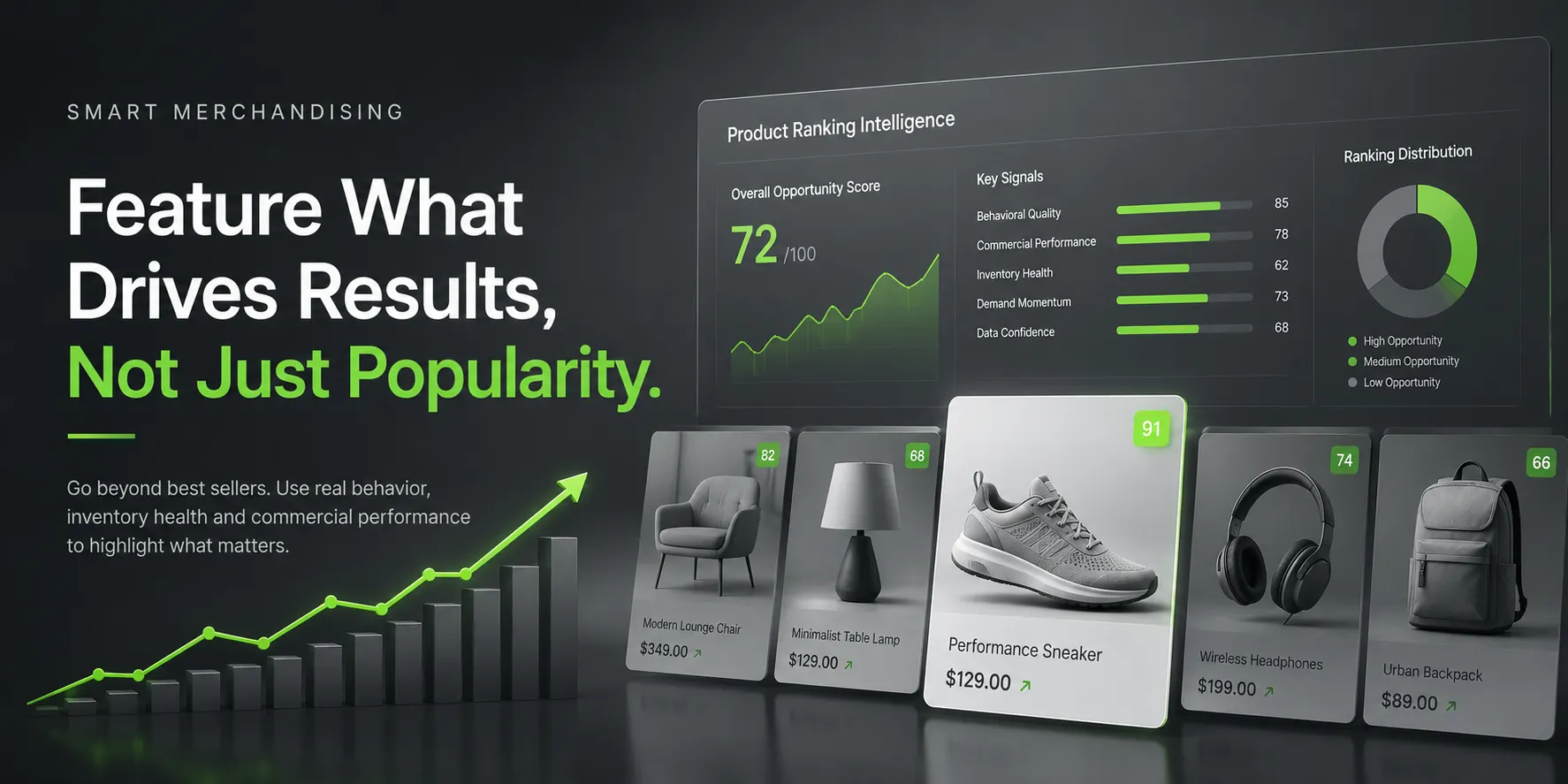
Which Products Should You Actually Highlight?
Why "Best Sellers" Are Often the Wrong Choice
Open the homepage of almost any ecommerce store and you'll find the same section, dressed up in slightly different language: Best Sellers, Trending Now, Most Popular. It's such a familiar pattern that nobody questions the logic behind it anymore. Popularity earned visibility. Visibility earned more popularity. The loop looked self-evidently correct.
It isn't, not always, and the reasons why are more interesting than they first appear. Featured product placement is one of the highest-leverage decisions in ecommerce merchandising, and most stores are still making it with a single number pulled from last month's sales report.
The Question That Sounds Simple But Isn't
Should you feature best sellers? Should you feature what's trending this week? Should you feature the products sitting in a warehouse with too much inventory? Should you feature new arrivals that just landed and have no sales history at all?
Ask an experienced merchandiser any of these questions and the honest answer is always the same: it depends. Not as a dodge, but as an accurate description of a genuinely conditional problem. What follows is an attempt to explain why "it depends" is the correct answer, and what it actually depends on.
Why Popularity Alone Is Misleading
Best-seller lists feel objective because they're built from real transaction data. Nobody's opinion is involved — the product either sold or it didn't. That objectivity is exactly what makes the metric dangerous to rely on alone. A product can sell well for reasons that have nothing to do with whether it deserves more visibility going forward: it launched during a seasonal spike, it was featured prominently for unrelated reasons, it had less competition six months ago than it does today.
Commercial performance is a real and important signal. It is also, by itself, a backward-looking one. It describes what already sold, not what deserves to sell more.
Why Sales History Creates Feedback Loops
Here's where the logic gets genuinely tricky. A product that sells well gets featured. Because it's featured, more customers see it. Because more customers see it, it sells even better. Because it sells even better, it stays featured. This loop can run for months with no one questioning whether the product's underlying appeal has changed at all — the position on the homepage is doing most of the work by that point, not the product itself.
The Rich-Get-Richer Problem
Researchers studying recommendation systems and content platforms have a name for this pattern: the rich-get-richer problem. Whatever gets initial visibility tends to accumulate more visibility, regardless of whether it remains the best choice available. Ecommerce merchandising built entirely on historical sales data is exceptionally vulnerable to this loop, because the metric used to decide what to feature is itself a product of what was featured before.
Why Most-Viewed Products Become Even More Viewed
The same dynamic plays out with view counts. A product that appears at the top of a category page accumulates views simply through position, independent of genuine interest. Rank it by views, and it stays at the top. Meanwhile, a genuinely more compelling product buried on page three of a category may never accumulate enough views to prove itself, not because customers don't want it, but because it never gets the exposure needed to generate the data that would justify exposure.
Why High Inventory Doesn't Automatically Deserve Visibility
Excess stock is a common reason merchandising teams reach for a product to feature — there's a natural instinct to sell down what's sitting in the warehouse before it becomes a write-off. That instinct isn't wrong, exactly, but it treats inventory health as if it were the same thing as customer demand, and the two are only loosely related. Featuring a product primarily because there's too much of it, rather than because customers actually want it, tends to produce weak conversion and a merchandising slot that isn't earning its position.
Inventory pressure is a legitimate business input. It's a poor primary reason to feature something, and a much better secondary consideration once genuine customer interest has already been established.
Why Low Inventory Can Create Customer Frustration
The opposite failure mode is just as costly and gets far less attention. Featuring a product that's about to sell out creates a specific kind of customer frustration: someone clicks through, gets excited, and finds it unavailable in their size or out of stock entirely. That's not a neutral outcome — it's a small trust cost, absorbed by the brand, at exactly the moment a customer was most engaged.
A merchandising decision that ignores stock sustainability entirely is optimizing for a click that may never convert into a completed order.
Why New Arrivals Have Insufficient Evidence
New arrivals present the opposite data problem from best sellers. There's no sales history to lean on, no accumulated view count, nothing but a hope that the product will perform. Featuring new arrivals by default — the way many storefronts do, simply because "new" is an easy category to define — treats absence of evidence as if it were evidence of quality, which it obviously isn't.
At the same time, refusing to ever feature anything without a sales history guarantees that new products never get the exposure needed to build one. This is a real tension, not a solvable-once problem, and it points toward something merchandising teams often underappreciate: the amount of confidence you should place in any signal depends heavily on how much data actually backs it.
Why Historical Sales Ignore Current Customer Behavior
A product that sold extremely well last quarter may be losing relevance right now, for reasons a monthly sales report won't reveal for weeks. Customer taste shifts. A competitor launches something better. A seasonal window closes. Sales data, by its nature, always describes the recent past — and the recent past is not always a reliable guide to what's happening in customer behavior this week.
Behavioral signals — how customers are engaging with a product right now, not how it performed historically — capture a different and often more current picture than transaction history alone.
Why Merchandising Should Be Dynamic, Not Static
Put the previous sections together and a clear picture emerges: no single point-in-time ranking stays correct for long. What deserves visibility this week is not necessarily what deserved it last week, and treating a merchandising decision as something to set once and revisit quarterly guarantees the storefront is running on stale information most of the time.
Behavior Changes Over Time
Customer engagement with any given product naturally rises and falls — interest builds after a launch, plateaus, and eventually fades as either the product ages or something newer catches attention. A static featured list can't track that curve.
Customer Intent Changes
What customers are actually looking for shifts with context — a browsing session in December looks different from one in July, and a first-time visitor's intent looks different from a loyal repeat customer's. Featured placement that ignores intent treats every visitor the same, which is rarely accurate.
Seasonality
A product that's genuinely excellent in October can be nearly irrelevant in February. Seasonality is one of the more obvious reasons a fixed featured list ages badly, yet it's still common to see the same "trending" section running unchanged for months.
Product Lifecycle
Every product moves through a lifecycle — launch, growth, maturity, decline — and the right merchandising treatment differs at each stage. A product in its launch phase needs exposure to generate initial data. A product in decline may need to step aside for something with more current momentum.
Merchandising Objectives Aren't Fixed Either
What "good" means for a featured product placement depends on what the business is actually trying to accomplish at that moment. Sometimes the goal is maximizing near-term revenue. Sometimes it's building awareness for a new product line, sustainably clearing aging inventory, or protecting margin during a discount-heavy season. These objectives can point toward genuinely different products, and a merchandising approach with only one lever — usually "feature whatever sold the most" — can only ever optimize for one of these goals, regardless of which one the business actually needs right now.
Confidence in Data Matters as Much as the Data Itself
A product with ten thousand views and a strong conversion rate tells you something quite different from a product with twelve views and a similarly strong conversion rate, even though the raw percentage might look identical. The first number is trustworthy. The second is close to a coin flip that happened to land favorably. Treating both with equal confidence is one of the more common and costly mistakes in ranking systems generally, not just in ecommerce.
Signal Reliability
Different signals carry different levels of reliability depending on how much data supports them, how recently they were observed, and how consistent they've been over time. A single strong day of sales is a weaker signal than a strong week. A conversion rate calculated from thousands of sessions is a stronger signal than the same rate calculated from a handful.
Balancing Opportunity Versus Certainty
There's a genuine trade-off between featuring what you're confident about and featuring what has real upside but hasn't yet proven itself. Lean too far toward certainty, and the storefront only ever shows established winners, starving new products of the exposure they need. Lean too far toward opportunity, and the storefront ends up promoting a lot of unproven products that underperform. Enterprise merchandising, done well, treats this as an ongoing balance rather than a decision made once.
Avoiding Overconfidence
A related discipline is resisting the temptation to draw strong conclusions from thin data. A product that happens to convert well in its first three sales isn't necessarily a hit — it might just be an early lucky streak. Systems that don't account for this tend to over-promote products that later regress, once a larger, more representative sample of customer behavior comes in.
Multi-Objective Optimization: Why One Metric Was Never Going to Be Enough
Every one-dimensional ranking eventually fails for the same underlying reason: it's answering a question that has more than one legitimate dimension with a single number. Rank purely by sales, and you ignore inventory sustainability and get customers excited about products that immediately sell out. Rank purely by views, and you ignore whether those views convert into anything. Rank purely by margin, and you ignore whether customers actually want the product at all.
Multi-objective optimization is the underlying discipline here — evaluating several, sometimes competing, priorities together rather than picking one and treating the rest as noise. It's a well-established idea in operations research and logistics, and ecommerce merchandising is, structurally, the same kind of problem: several legitimate goals that don't always point in the same direction, requiring a system built to weigh them together rather than a spreadsheet sorted by a single column.
Behavioral Quality Versus Raw Popularity
Not all engagement is equal. A product viewed ten thousand times with almost no one adding it to cart is telling a very different story than a product viewed a thousand times with strong add-to-cart and completion rates. Raw popularity counts activity. Behavioral quality asks what that activity actually meant — whether the engagement reflects genuine interest moving toward a purchase, or just casual traffic passing through.
A merchandising approach that can't distinguish between these two kinds of attention will systematically favor products that attract a lot of shallow interest over products that attract a smaller amount of serious, purchase-oriented interest.
Why Enterprise Retailers Rarely Rely on One Metric
Talk to merchandising teams at larger, more mature retailers and a consistent pattern shows up: nobody making real placement decisions is looking at a single ranked list sorted by one column. They're weighing sales performance against inventory position, factoring in how recent and reliable the data is, considering the current business objective, and adjusting for how a product has been trending over the past several weeks rather than the past year. It's rarely automated in any sophisticated way — often it's a merchandiser's judgment, built from years of pattern recognition, effectively doing multi-signal evaluation manually.
What smaller and mid-market ecommerce brands often lack isn't the insight that one metric is insufficient — most experienced operators sense this intuitively. What they lack is the tooling to evaluate multiple signals together, continuously, at the scale their catalog requires, without a merchandiser manually reviewing every SKU every week.
Why Modern Merchandising Systems Evaluate Products Continuously
The natural response to everything above is that featured product decisions shouldn't be a static list revisited occasionally — they should be a continuously updated evaluation, re-assessed as new data arrives, as inventory shifts, as customer behavior changes, and as the business's own priorities move. A product that deserved a featured slot last week might not deserve it this week, not because anything dramatic happened, but because the underlying signals quietly shifted in ways a monthly review would miss entirely.
Why Ranking Products Is a Prediction Problem, Not a Reporting Problem
This is perhaps the most important reframe in the whole discussion. A report tells you what happened. A ranking used to decide what to show a customer tomorrow is implicitly a prediction about what will perform well tomorrow, based on everything known today. Treating merchandising as a reporting exercise — sort by last month's sales, done — mistakes a forecasting problem for a bookkeeping one.
Product ranking as a prediction problem means the goal isn't to accurately describe the past. It's to make the best possible estimate, given imperfect and incomplete information, of what deserves attention next — which is a fundamentally different exercise, and one that benefits from combining many signals rather than trusting any single one completely.
What This Looks Like in Practice, Without the Formulas
Without getting into the mechanics of how any particular system weighs these things — that's genuinely proprietary territory for the platforms that do this well — it's possible to describe the categories of information a serious merchandising evaluation tends to draw on simultaneously:
- Customer engagement: how people are actually interacting with a product right now, not just whether they viewed it
- Commercial performance: sales and conversion, weighted by how much and how recent the data is
- Inventory sustainability: whether stock levels support sustained visibility without risking stockouts or overcorrection toward excess
- Behavioral quality: whether engagement reflects genuine purchase intent rather than shallow browsing
- Confidence in available data: how much a given signal should be trusted, based on sample size and consistency
- Business context: what the store is actually trying to accomplish right now, which can shift the right answer entirely
None of these categories is sufficient alone. Together, evaluated continuously rather than as a one-time snapshot, they start to approximate what an experienced human merchandiser is doing intuitively — just at a scale no human team can sustain across a catalog of thousands of SKUs, updated in real time rather than reviewed once a quarter.
Where This Is Heading
Some modern ecommerce intelligence platforms are beginning to move away from static merchandising rules — sort by sales, sort by views, sort by discount — toward continuously evaluating products using multiple business signals at once, updated as behavior and inventory shift rather than recalculated on a fixed schedule. Peloran is one of the platforms building in this direction, treating featured product selection as an ongoing evaluation across engagement, commercial performance, and inventory health rather than a list someone sorts once and forgets.
The specifics of how any platform balances these signals are, reasonably, not something worth publishing in detail. What's worth understanding, as a merchant, is the underlying shift: the question of what to feature is not a lookup against last month's best sellers. It's an ongoing judgment call that good systems — human or software — are built to keep making, continuously, as the picture keeps changing underneath them.
Frequently Asked Questions
Should best-selling products always be featured?
Not automatically. Sales history is a useful but backward-looking signal, and past performance doesn't account for current inventory position, changing customer intent, or whether the product's recent momentum has already started to fade.
Is it a mistake to feature products with excess inventory?
Not inherently, but inventory pressure alone is a weak primary reason to feature something. It works best as a secondary factor once genuine customer demand has already been established through other signals.
Should new arrivals be featured by default?
Featuring new arrivals purely because they're new treats the absence of sales data as a positive signal, which it isn't. At the same time, never featuring unproven products prevents them from ever accumulating the data needed to prove themselves — this is a genuine balance to manage, not a simple yes or no.
Why can't a single metric reliably rank products for merchandising?
Because merchandising decisions involve several legitimate, sometimes competing priorities — commercial performance, inventory sustainability, current customer behavior, and business objectives — and a one-dimensional ranking can only ever optimize for one of them at a time.
How often should featured product placement be updated?
As often as the underlying signals meaningfully change, ideally continuously rather than on a fixed monthly or quarterly cycle, since customer behavior, inventory levels, and seasonality all shift faster than most static merchandising schedules account for.
Closing Thought
"Best sellers" is a comfortable default because it's easy to compute and hard to argue with in a meeting. But comfort and correctness aren't the same thing, and a ranking built on one number will always miss the parts of the picture that number was never designed to see. The stores that get this right aren't the ones with the fanciest homepage section. They're the ones that have stopped treating featured product selection as a report to generate and started treating it as a question worth asking, continuously, with more than one piece of evidence in hand.